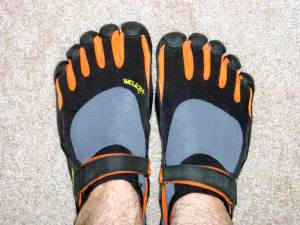
Fixing my feet – send in the Five Fingers.

I have a confession to make.

I have flat feet.

For as long as I can remember, people have been telling me that I have flat feet, or that I over-pronate, or that my arches fall when I stand on them.

And they were right in their diagnoses. However, I am beginning to think they were wrong in their prescription.

Their prescription, every one, was that flat feet were something you lived with, and used orthotics to help reduce the pain associated with fallen arches, or at least to reduce the effect of the fallen arches.

Studies show it doesn’t work, at least not well, and that there’s no hard and fast way for prescribing orthotics… Which indicates (to me) that we’re dealing with snake oil, being sold a bill of goods. But charlatans sell snake oil for the same reason people sell orthotics – lots of people have some sort of malaise (or sore feet, in the case of orthotics) and are willing to spend a sum of their hard earned money on the promise of improved health. And while SOMETIMES the orthotic ‘cures’ the pain (treats and/or masks the  symptoms), it doesn’t solve the problem. As an orthotics wearer, you become dependent on it, and without it, you are miserable.

My footprints in the snow.

So I’ve decided that this is not something I want. I’ve never been formally fitted for orthotics (custom orthotics range between 100 and 200 USD, typically), I’ve spent my fair share of dollars on different over the counter orthotics, with varying degrees of success (read: pain relief). Superfeet even shrunk my feet (by seemingly improving my arch, as improbable as that seems).

The problem with orthotics, as I see it, as it gives your body a crutch – something to be lazy on. And every body in the world is content to be lazy if at all possible. It’s a natural way to conserve energy, and from a physiological standpoint it makes perfect sense.

So, after recently hearing all about my arches and how low they are, I’ve decided to do something about it.

I’ve had my Vibram Five Fingers for at least a year, now, and I’ve worn them off and on. I’ve never been much of a runner, so I’ve never really worked myself up to running in them, but I love them. I think they feel good, fit well, and make it so I can

walk around with a fairly barefoot feeling wherever I go. So I decided to start wearing them daily, to see if what Dr. Nirenberg says is true.

What I did not do was take a ‘before’ stamp of my footprint. But I have started doing some mild running in my Vibrams – keeping the distances under an 1/8th of a mile at a time for now (doing intervals of 200m between 5 and 8 times.

But I will be sure to take a 2 month stamp, and a 4 month stamp. Hopefully I will be able to see a marked change in the pattern of my foot, as well as a well-defined arch.

What about everyone else

? Do you have any experiences with (re)training your feet and the (re)introduction of an arch due to barefoot running or any other method? I know there’s some surgical procedure out there right now that involves some sort of a metal tube inserted into the ankle, but that kind of seems like a last resort… Like I might consider it… after exhausting any other ideas that are less invasive.

And besides, it seems like a pretty hardcore way to correct something that may not even be the problem it’s made out to be.
What are your thoughts?

Modern humans are all anachronisms

An aboriginal man

An aboriginal man

We are the same as our ancestors.

Physiologically, mentally, and pathologically, modern medicine has found that many traits, diseases, and characteristics run through family lines. There are countless studies, specifically studies into heart disease,  cancers, and some mental disorders. We also tend to look like our forbears, as well – which is something so commonplace that the first thing one does when introduced to an infant is to determine which parent the child looks like. In turn, the parent resembles one of both of their parents, ad nauseum.

It stands to reason that we also inherited the internal functioning of our forebears as well. And, going back, we find that modern man hasn’t significantly changed in a long time. Heights have been roughly the same, as have behaviors, preferences, and skills and activities. However, there have been several recent introductions into human living which have fundamentally altered those behaviors, preferences, skills and activities. Some of the introductions have been beneficial, while others have been detrimental.

The grasslands, forests, canyons, and coastlines of our forebears have been largely replaced by city streets, on-ramps, and towering buildings. The others still exist, but fewer and fewer people live out among them, and even when they do, they largely live apart from what is and should be considered their natural habitat. Electricity, communications, heat, just-in-time worldwide delivery – these separate us from our natural environment. The rise and set of the sun is irrelevant to our day to day lives. Our needs for protection and shelter are largely covered, and we no longer have to worry about it on a day to day basis. We no longer worry about food storage or making it through the winte

modern humans

modern humans

r, meat comes packaged in sterile Styrofoam and bone-free – we never even have to think about how the animal that we’re eating had a skeleton, let alone a face. Fruits and vegetables are available year round, picked early and gassed to force ripening. What’s more, we’ve hybridized the fruits and vegetables that we do eat, making them sweeter, bigger and more desirable. They look perfect, are free from any disease or pestilence, and completely sterile.

However, there is a part of every human that yearns for their natural habitat. Mountains are beautiful, we will sit and watch the sun go down, remarking over the colors and the complexity and the beauty of nature. This causes us all to feel a displacement that modern society and civilization instills in the populations which created it. And while we are all able to cope with situations and events, we have to ask how badly this affects our coping baseline, to have to feel as though we are living in some sort of exhibit, manicured and falsified to give the impression of nature, but far, far away from the habitat in which we belong.

We are a species living out of time and place thanks to our own devices. The advances made in society and civilization were made at the expense of a vast, deep part of ourselves which we are just now beginning to realize. There are a multitude of ‘self-help’ regimens and ideologies dedicated to solving the disconnect we feel with our world, our food, and our personal interactions, from Abs Diet to Vegan, from ab crunches to communications to inner peace. These are all designed to help us get what we want – a deeper connection and a sense of meaning and purpose, which has been lost as we have lost our connection with what is truly our nature.

Physiologically, we are not meant to be sequestered from the sun, confined to a chair, or a treadmill, or to stay up until the sun rises. Our lives, though safer, have been routinized, confined, and boxed up in such a way that we have no escape from the stresses we endure because of it. We are safe, but the safety induces the stress that it ever so slowly killing us all.

your feet are your foundation

Shod, but barefootFeet…. for the most part, we all have two of them. We use them every day to get from point “A” to “B” to “C”.

Thousands of years ago, men, women, and children of all social strata were minimally or not at all shod. A typical example of a primitive ‘shoe’ would consist of a strip of leather to protect the bottom of the foot and a strap to keep the leather ‘tied’ to the foot. This was called a Huarache, and there are still tribes (and modern runners) that wear them on a regular basis. They were simple, cheap, and effective.

As ‘civilization’ progressed, different cultures developed different styles of shoe, ranging from simple wooden clogs to silken slippers placed on women’s feet to prevent them from growing correctly at all. Every single shoe had a problem – it took the foot out of the equation of walking.

An Amazing Machine

The human foot is an amazing machine. A fully grown adult will have 26 bones, 33 joints, and dozens of ligaments, tendons, and muscles. They are also contain thousands of nerve endings. All this complexity exists for one thing – to allow a human to walk – or run – from point “A” to “B” to “C”. It is truly an amazing machine, and to have two of them strapped to the lower half of your body is really a stroke of luck, because they are meant to be used in pairs. Of course, they can be used singly, but they “work” together.

The basic idea is this:

  • the muscles move the foot into place on the ground.
  • the nerves send information to the brain, so the brain can make decisions based on those inputs about how the muscles will react.
  • the muscles react according to the brains commands, contracting and relaxing as instructed.
  • the muscles, which are attached to the bones via ligaments pull the bones. The tendons help to keep the bones aligned.
  • the joints articulate in such a way to keep the foot supported, other joints protected, and the body protected and upright.

A pretty simple process, on paper. Now, enter shoes.

How we went wrong

The first shoes were little more than leather wrappings around the foot. As society, particularly European society, evolved, so did shoes. They became boots which constrained the foot, often fitting poorly with either too much or too little room. Toes changed from blunt boxes to ‘elegant’ points and became quite the symbol of style and affluence. Most shoes were not designed specifically for your left or right foot, but were rather uni-fit shoes, which would just go on whichever foot you pulled them onto.

Your foot’s nerves, ligaments, bones, and muscles were given no consideration at all. And why should they? The need to run, jump, and be limber and nimble was something from a fanciful past where one had to chase live animals for food, or run from predators. It was barbaric. Shoes which did not cater to the gymnastic past of our predecessors were a symbol of how far societies had come. There was nothing primal to fear, any more, so why bother keeping your body, mind, and nervous system tuned up for such an endeavor? Better to keep it tuned for enjoying music, or food, or fine clothing.

And that’s pretty much the way it stayed until societies advanced enough that we could begin making rubbers, and plastics, and machines that could build a reliable product over and over and over again. Which is exactly what happened. Shoes were growing up, baby, and they were softer, more supple, and more colorful than ever! We could make all kinds of different shoes for different activities, with different levels of cushion and heel drop, different uppers and colors and fabrics and wizzbangery. Our feet were just getting more and more awesome with every iteration.

But they really weren’t.

The shoes, with their arch supporting, torsion controlled lumps and ridges do not t actually help our feet at all. They effectively freeze many of the muscles and joints into a fixed place within the shoe. Because of this, the nerves send out alarms to the brain, to let the brain know that something is going on with the foot. The brain knows that there’s nothing exactly wrong, and eventually just turns off the song and dance offered up by the nerves, kind of the way it tunes out the car alarm that is always going off in the parking lot. The modern shoe turns the foot into one large monolithic slab, causes our bodies to strike our heels on the ground when we walk and run, and just generally destroys our gait. The shoe is designed to mitigate this – through gels, air, and multi-desnsity foams – and make your foot feel as though it is moving atop a fluffy cloud of goo.

And it gets worse

It appears as though the more sophisticated shoes get – offering increased arch support, stability, etc – the more the foot can relax and get lazy. This leads to all kinds of issues – foot and ankle injuries such as sprained tendon, plantar fasciitis, tendonitis, pulled muscles, and damaged and degraded joints. The foot, allowed by the shoe to be lax, also loses its natural arch.

Arches are a girl’s best friend (and you thought it was diamonds)

The body is full of arches. There are arches in the spine, legs, and, yes, feet, that help reduce shock from activity, including walking, running, and jumping. Without our arches, we are more prone to injury, and can even face aggravated injury from the lack of our body’s natural shock absorption. For instance, an incorrectly aligned spine can actually increase the force of an accident instead of dissipate the force. When you lose an arch, you potentially face increased pain and risk of injury. So it’s important to keep all your arches healthy.

But I’ve already lost my foot arches. Is all hope lost?

Modern medical treatment of fallen arches and other foot issues is through the use of orthotics. However, recent studies into the somewhat mysterious field of orthotics reveal one thing – that they don’t know what in the hell they are talking about. There seems to be little science and more art, guesstimation, and downright dumb luck in finding a good orthotic. Good thing, too, because these babies aren’t always cheap. The orthotics industry makes millions upon millions of dollars every year in the US. From Dr. Scholl’s to Superfeet to custom orthotics, many living in the US turn to orthotics to offer some relief to their feet. But adding something else, it seems, is not what the foot needs at all.

Another recent study by Dr. Nirenberg found that increasing barefoot or barefoot-like activities led to an increase and return of the natural foot arch. Bolstering this study is many anecdotal stories across the western world describing how barefoot activies led to a return of the foot’s natural arch and improved function as well as reduced pain levels and injury risks.

So what are you waiting for?

Get out there and go barefoot!

Not ready to jump in whole-hog? No problem. There are lots of shoes out there designed to help you make the transition.

www.vibramfivefingers.com

www.merrell.com/US/en/Barefoot

birthdayshoes.com/fila-skeletoes-toe-shoes-exclusive-sneak-peak

www.softstarshoes.com/index.cfm