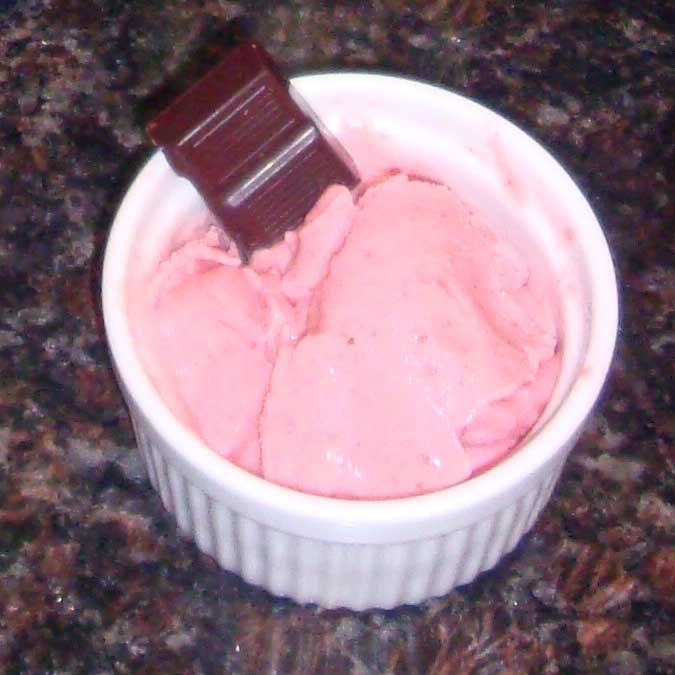
Coconut milk ‘iced cream’ in five minutes!?!

Strawberries!

Even we of the primal-set aren’t so austere that we don’t enjoy a good dessert every now and again. This one is easy, delicious, and makes a delicious iced cream substitute. (In fact, this recipe might even be considered… vegan!) Basically, it’s an easy iced cream analog that takes almost no time to make up and is tasty, wonderful, and about as simple as you can get. Without further ado, here is the LONG list of ingredients:

  • 1 14 oz can of Coconut milk
  • 14oz of FROZEN fruit (we generally use berries, but you could theoretically use any fruits – besides, berries are more primal-friendly, right?;)
  • 3 tablespoons of honey (or to taste. I think that 3 tablespoons isn’t too sweet, but less wouldn’t have been horrible, either).

That’s it. Now for the instructions…

  1. Scoop the coconut milk into a food processor, and blend until no longer lumpy.
  2. Throw in your frozen berries.
  3. Add your honey.
  4. Blend until everything is smooth and the consistency of iced cream.

And that’s it! It’ll be soft, but it’s ready to eat right now. If you want, you can drop it into a bowl and throw it in the fridge to set up further. I’m not sure on how long it will keep in the freezer, but it won’t last long!

Other thoughts I’ve had regarding this treat:

  • Blend then freeze (in an ice cube tray) a can worth of coconut milk. Prepare as above, substituting the frozen coconut milk for the fruit. Add in vanilla to taste.
  • Follow the above steps, but add dark chocolate instead.

Good luck, and remember: it’s about having fun and getting in the kitchen and trying things out!

Enjoy!

Still life - Flowers, iced cream, chocolate and rabbit

Question and Answer

I get questions like these quite a bit. I finally decided to take my thoughts and concatenate them into a single post. Hopefully it helps you, too!

What would be a good daily eating plan?
I want to get in better shape, weight included.

There is so much info out there on carb this, fat that…

It’s overwhelming.

-anonymous

Well maybe it is overwhelming, but there are a couple of ways to mitigate that.

First, you should start thinking about your body like a mini chemistry set. You put chemicals (food) in, and see what happens. The neat thing about your chemistry set is that it has a pretty quick response time – within 30 days, you should have noticable, measurable results.

Second is that you need to introduce some information filtering. Most of the ‘studies’ you see on the news are epidemiological studies (http://en.wikipedia.org/wiki/Epidemiology) and have questionable validity (for instance, by listening to the news, you would assume that cholesterol was the most evil thing you could put in your body, when in fact your body (and brain in particular) NEEDS cholesterol to survive). But I digress. You need to stay focused on your goal like a laser beam. Again, it’s only 30 days, and from there you can adjust as needed. But I think that if you don’t give something at least 30 honest days, you cannot comment on it’s validity or efficacy.

Finally, You’ll have to tailor your eating plan to your own preferences and food choices. That said…

I would recommend a fairly strict paleo regimen for a 30 day period. It’s not easy, and it requires that you get the ‘bad stuff’ out of your house (so you’re not tempted to go back and ‘cheat’). But it is something that is achievable and realistic.

The goal is simple: on the standard western diet, your body becomes acclimated to running off of sugars and carbohydrates (both of which your body needs, but more on that later). However, in order to run off of those types of things (sugars, and specificially glucose), your body will produce increased levels of insulin (for a good description of how insulin works and can cause you to gain fat, watch the movie Fat Head (http://www.hulu.com/watch/196879/fat-head) on Hulu), which in turn can cause your body to store fat. This is only one of the things we are trying to avoid, but for the goal of weight loss, it is an important one.

In addition to higher insulin levels, we’re also looking to avoid items in many of the low level toxins found in many different sources of carbohydrates. These toxins are a protective response to prevent animals and bugs from eating the seeds (offspring) of different plants. These include saponins, lechtins, and phytates (phytic acid), and are considered ‘anti-nutrients’ in that they actually hinder absorption of vitamins and minerals in the stomach and intestine.

We’re also looking to avoid inflammatory foods – at the very least for the duration of the 30 day period. Our goal with this is to reduce overall inflammation in the body and promote anti-inflammatory consumption throughout the process.

Finally, we’re looking to replace high-caloric, low-nutritive foods with low-caloric, high-nutritive foods. This is accomplished by doing what your mom always told you… you have to eat your vegetables. It can be hard for some people for sure, but it’s an important thing to note, nonetheless.

So all that said, what does this mean for what we don’t want to eat in order to fulfill the requirements above (don’t think if it as “I can’t eat this or I can’t eat that,” as it is a sure path to failure. You’re not depriving yourself, you’re restricting what you want to eat based on very specific goals and criteria.)? Well, lets investigate that a little further.

What? Wheat!

First off, the biggest items to restrict completely (at least for the 30 day experimentation period) are ALL grains. Period. This means no wheat, oats, sohrgum, quinoa, corn, barley, rye, etc, etc etc. None. They are gone from your diet completely. The next is most legumes. Most paleo regimens allow for green beans and snap/snow peas (despite the fact they are legumes) because they are mostly pod. Other than that – ditch the beans. We also need to dump the sugar and processed foods. They’re full of transfats (oils tortured out of the seeds and legumes we are trying to avoid) and sugar and salt. You don’t need any of that, so they’re all out.

Finally we get to dairy. Dairy is inflammatory, and you can do without it for 30 days (and introduce it back in, if you so choose, later). The noticable exception here is butter from grassfed milk (see Kerrygold, for example). Other than that, no milk, no cheese, no whey, etc. Just stay away from the dairy.

A few last things to avoid: Juices, sodas, energy drinks, or anything where you are consuming calories through liquid. It’s just a bad idea.

Also limit alcohol intake, especially in the first 30 days. (alcohol to drink, in order of least inflammatory to most, is clear distilled non grain alcohol (gin, vodka, etc), wine (red, then white), and beer.)

Beef, beef, it's good for your heart

So now we get to what we want to eat. Meat is good. It is full of the protein and saturated fats that your body needs, and that we are focusing on converting your body to run off of. The best kinds of meat are grass fed and pastured. Grain fed animals will have some of the inflammatory properties of the grains they are fed (weird how that works, right?) Beef, fish, lamb, and pork are all considered fair game. With beef, go for grassfed, and for fish, wild caught. Lamb is always grassfed, and pork never is (pigs eat all kinds of things, so they are higher on the inflammatory spectrum).

Vegetables!

Additionally, eat lots of vegetables. I cannot overstate how many vegetables you will end up eating. Cruciferous veggies (broccoli, cauliflower, brussels sprouts) are all fair game. Kale, lettuces, bok choi, beets, radishes, carrots, chard, onion, cucumber, spinach, celery, etc. are all fair game. There are lots of vegetables that are higher on the carbohydrate scale (important if you are working out and expending lots of energy) including winter squashes (acorn, butternut, carnival, spaghetti, etc) and sweet potatoes (both the white and the orange). All are good for you and full of vitamins.

You can eat SOME nuts. I tend to stick to macadamia nuts as they are low in omega 3 fatty acids, which is important when considering inflammation. (They are also buttery and delicious, so that helps, too). Don’t eat too many, though.

You can also eat SOME (like one serving per day) of fruit. Fruit is high in fructose, which the body processes in the same way it processes ethanol, and overconsumption of fructose has led to the creation of a new disease – non alcohol related fatty liver disease… bad news.

Other than that, the rules are:
1) eat when you’re hungry.
2) eat until you are satisfied.
3) do not count calories.
4) Have both a protein and carbohydrate source whenever you eat.
5) Stick with it for 30 days.

Additionally, it is important that you get a benchmark. Weigh yourself, and measure your total inches (measure at the midpoint of each bicep, your waist at the belly button, your hips, and each thigh at the midpoint). In addition to your total inches, measure your neck at as well, as you can use it to help determine your body fat percentage using the US Navy calculation (there are lots of calculators on line, and you need both your neck and waist measurements in order to calculate it. Take pictures in as few bits of clothing as you feel comfortable in. It won’t be pretty. It will show you your changes, and will be important for your measurements.

So, if you’re sold on trying it, head on over to Robb Wolf’s website, where he has a free quick start guide, food matrix, and shopping list (http://robbwolf.com/book-resources/). It’s not hard, but it does require a bit of perserverance and dedication. It’s HARD to find things to eat on the go, so it’s important to plan ahead.

Good luck and let me know how it goes!

Three Months on the primal fringe – Part Two

30 days

handstands

Handstands in the National Park

I started immediately. No more hamburgers, pastas, or bread with dinner. No sandwiches or crackers. I made it my goal, and decided that it was going to be easy to do it for 30 days.

And it was.

I was amazed at how good I felt. Everything made sense. There are reasons humans like meat and fats (and some sweet things). Just like a goat or a cougar knows what it needs to survive and what kind of food that it needs to eat in order to live and thrive, so does the human animal. But we’ve gotten smart enough that we can turn it off, or altogether ignore it. And when you really start to think about it, that’s not such a smart thing, in the long run.

After a couple of days had rolled by, I talked my wife into doing it, too. It was just going to be easier, it was something that we had been talking about anyway (at least changing up our diet and eating better quality food was), and this seemed like something easy to try for 30 days. With her on board, things got even easier.

Breakfasts consisted eggs, meat, and veggies, all cooked in either bacon grease or coconut oil. Olive oil was regulated to salads, which were frequent lunchtime events. These weren’t just little salads, but rather epic excursions full of leafy greens, cucumbers, tomatoes, radishes, onion, mushrooms, and of course some sort of meat. Usually I would top them with a half or a quarter of an avocado, and round that all out with some balsamic vinegar and olive oil (with just a splash of Dijon mustard to hold the whole dressing together). These salads generally fit into the largest tupperware we owned, and usually it was enough.

Squash Fever

Dinners were varied but simple, consisting mainly of meat and vegetables, sometimes a salad as well. Since we were working ourselves fairly strenuously with CrossFit, we decided a bit of starchy carbohydrates were called for. We added sweet potatoes (already a family favorite), and various squashes to our meals. In addition to being good for us, they kept us stocked with the carbohydrate energy our bodies and minds needed to survive the new taxing situations they were being put into. It was a perfect fit.

Additionally, we still had a small indulgence of a small piece of dark chocolate daily. It was the one simple thing that we were able to do in order to keep my wife from going crazy. Plus, it was a delicious way to end a day. Our favorite is a dark mint chocolate we were able to find with minimal ingredients. It’s delicious, full of antioxidant goodness, and simple. Sometimes (usually) that’s all you really need.

Our diet contained no dairy, little fruit, and no legumes or grains of any kind for thirty days. During that time we experienced different reactions to the purification of our food intake. We ate until satisfied, and did not once count a calorie.

Benefits

There were several benefits, for me in particular. I had previously suffered from what had become chronic nasal allergies. The daily and nearly constant allergic discomfort had started nearly two years ago (although looking back now, I can see even as far back as ten years ago the telltale signs of the allergy – and I attributed it to milk… more on that later) and had progressed to the point where I was taking a maintenance dose of over the counter Costco variety Claritin. I had played with my diet earlier, removing dairy only from my diet, but it had really not had a significant effect. Ridding myself of grains and/or legumes, however, did seem to do the trick.

At first, I noticed that my allergies seemed less, but was still fearful of removing the lortadine completely. The sneezing and itchy, watery eyes could get unbearable. As time went on, I noticed I was still feeling better. I started to wean myself off of it, hopeful that I had unlocked the secret to what had been ailing me for a number of years. Within a week I was only taking it intermittently (two or three times a week, as opposed to seven). Within two weeks, I wasn’t really taking it at all. It appeared as though I had solved the riddle.

Another benefit was what equates to rapid weight loss. Yes, we were working out hard with Crossfit. However, our workouts were in general less than a half-hour in length (the WOD in particular – the warm up, strength, and agility training brought the total time to an hour) three times a week. There is no way to burn enough calories in three hours max per week to lose the amount of weight that I lost without the significant change in diet. If the workout was doing anything, it was actually inflating my numbers.

In fact, to look at my calculations I went from 19.19% bodyfat at the beginning of the year to a current body fat percentage of 12. Additionally, over the last month (March 8th to April 20th, it’s also calculated that I GAINED approximately 4.5 pounds of muscle while losing over three pounds total. So in terms of effectiveness, this has been a very effective weight loss tool, though my reasons for doing it were not at all weight driven. (Oddly enough, using BMI calculations, I am still overweight at 12% bodyfat, and what’s more, a ‘healthy’ range – again according to BMI for someone of my height would be 152# – 205#. At 152#, I would be a skeleton dancing around for all to see. No thank you. I’ll happily remain ‘overweight’, thankyouverymuch.)

We saw other benefits, including some you wouldn’t expect. Whiter teeth, clearer skin, and improved mood were all on the list of benefits. In short – it was good to be grain free.

Fast forward three months, and our diet has not really changed. Legumes do occasionally find their way into our meals (rarely and never at home), as does wheat (again never at home). We’ve thoroughly advertised and socialized through our families that this is the way we are choosing to eat, now, and that we have experienced many positive benefits from doing so and are not interested in regressing these benefits. We have reintroduced SOME dairy into our diets, but we’re mostly eating artisinal raw milk cheeses, which are high in flavor and fat and therefore don’t require a ton to introduce that wonderful cheesy flavor.

Additionally, when I eat some grains (wheat specifically, so far as I know. Corn doesn’t seem to be as much of an issue for me), I get stuffed up within an hour or so and have to take a claritin. Beer seems to have the same effect on me, as well, so in general I kind of make it a point to stay away from wheat – which is sad, because I love a good beer. But now I know the result and the cause, and can make a risk assessment before I drink a beer or eat a sandwich. Usually, it’s not worth the consequences and I choose to not have them (and I’ve never yet had it be worth it to have a sandwich, but there have been a few beers here and there:).

So as of today, I’m happy, healthy, and stronger than I’ve ever been before. I feel great and wouldn’t give it up for the standard American diet in any way, shape, or form. (Which is not to say I don’t every once in a while have a desire to have a thick smear of butter on top of a half a sourdough roll – but that’s really more for the sake of the butter than anything else.)

The other massive boon to our existence and well-being has been the gym. We made the choice to try it out, and we love it. We’re gaining strength, skill, and agility faster than we ever have before (in our adult lives). It’s truly been an amazing year.

So get out there, and try life on the fringe. It’s a lot of fun, you feel great, and you get to challenge yourself. If you can’t go 100%, then just push yourself as far as you can. Any time you have something you probably shouldn’t or do or don’t do something, it’s not the end of the world. It’s just part of life. Failure is an option, and it’s the only way we find our way to success.

What about your stories? Have you spent any time on the fringe? What are your experiences or thoughts? I would love to hear them.

Robb Wolf’s Liberty Garden concept

Lettuce have some salad!

One of the most important things you do every day is make decisions on what kinds of things you will use to fuel your body. Beef or chicken? Grassfed or storebought? What kinds of veggies? You gonna throw some corn down, or perhaps a big-ass sandwich? Maybe that’s not such a great idea.

Regardless of the choices you ultimately end up making, the choice itself is an important one. Your body is – without a doubt – the most important thing you own. How you choose to fuel it should respect that level of importance, in my opinion. And herein lies a problem inherent in the system – you can make good choices that still end up being less good choices based on how that fuel was raised/grown/created. And while you may not be able to fully know how all your fuel was created, it’s important to take those baby steps to getting to where you would like to be. (If you’re happy guzzling Mountain Dew and Ritz crackers, you can pretty much disregard this. Realistically, you’re probably not reading this anyway.)

Enter the Liberty Garden concept as promoted by Robb Wolf. Here’s the concept in an even smaller nutshell than Robb’s site talks about it: You are what you eat; in order to know what you’re eating, you should grow some of it because factory farming is involved in practices that can be called questionable (not to mention non sustainable), and that a great way to start it is using your own yard/kitchen window/balcony/veranda/fire escape/WHATEVER to start growing some of your own stuff. Sounds easy, right? It is! Just throw some seeds in some healthy soil (dirt is such a dead sounding word), keep it watered as per the directions on the back of the package, make sure the plants have adequate sunlight, and voila! instant food.

The Liberty Garden – Robb Wolf

To start, I would recommend some herbs. They’re usually very resilient and do well. If you think you have a black thumb, go with these to start. They’re almost a sure thing.

So what are you waiting for? Get out there, and get growing!

Three months on the primal fringe-Part One

On Tuesday, April 5th, I will have three months under my belt in my transformation from a rather marshmallowy everyman into an old-is-new archetype. I have lost 18 pounds (230 -> 212) in that time, monitored changes in my body measurements and lost nearly 3 inches overall, while actually gaining inches in my legs and arms. I can do pullups, both dead-hang and kipping, and can run a mile at a respectable speed. I’ve learned the basics of the Olympic lifts, and my max weight on those has been steadily increasing. Overall, my strength has increased dramatically, and I just feel better.

In addition to all that, my allergies have let up to the point where I only intermittently take Claritin, and even then only on the bad days. I have not gotten sick despite working in an office building in a large city where it will hopefully someday stop raining. I rarely get acne or outbreaks, but even the acne I did have seems to be less. My skin in general is healthier – color, elasticity, the whole nine yards. The jury is still out, but it is starting to look like gray hair which had begun sprouting when I was 19, has begun to come in dark once more. My teeth are whiter. I’m sleeping better.

I have been toying with the idea of doing this stuff for years.

I have been aware of Crossfit as well as the paleo method of diet and had looked into it, but thought “Nah, there’s nothing in this for me.” I felt pretty healthy, was in better shape than most of my colleagues, and was in general doing well. Crossfit seemed ‘too hard’, or ‘too intense’. I stuck to spin classes and cycling. My back was weak, so I suffered through back pain from the cycling. I couldn’t quite hold my body rigid over the bicycle, and relied too much on my handlebars. In reality, what I had thought of as ‘doing pretty well’, was in fact kind of ‘being lackluster’. I effectively was lying to myself, justifying my fitness by comparing myself to other people around me. This was a mistake. I was surrounded by people that spend their time in offices and whom are not, in general, athletic. So while I talked myself into thinking that I was doing pretty good in the grand scheme of things, deep down I knew I was fooling myself.

Wherein I learn the truth

The new year was fast approaching, and I had been thinking about my health and wellness as well as my wife’s. We had a new little one that had just turned one, and was beginning to take his first steps. I knew where this was headed – running, jumping, playing, etc. Neither my wife nor I wanted to miss out on that because of our health. I began looking for solutions.

We had recently moved to a new city, so I began to look around for a gym. I wasn’t interested in a gym that was shiny and glittery, or a gym that was tiny and filled with machines. I wanted something real. I remembered Crossfit – indeed I had been watching the main site’s WOD’s (workout of the day) for a while now, but never doing any of them. I looked up crossfit gyms in the area. There were two nearby.

Call it providence, good timing, or just flat out good luck, but I found that one had an end of the year deal going on, and additionally offered an introduction program for new initiates. This intro program was designed to acclimate an individual untrained in the sport of fitness that is offered by crossfit, as well as train them in many of the movements and lifts which would be frequently used in the WOD’s offered at the gym. After asking a few questions of the gym owner, particularly surrounding the fact that my wife was traveling fairly far outside of her comfort range, we signed up. I had a good feeling about this place, despite never having been there. I was excited.

I get whipped

The first week was the sorest that I think I have ever been. We ran, lifted little or no weight, practiced ‘double unders’ (a method of jumping rope where the rope travels under your body twice for every jump you make), box jumps, pullups, pushups, situps, deadlifts, and a myriad of other movements. I was torched. I ached everywhere. I started taking fish oil to help lubricate my joints. Glucosamine chased that, as well as a nice morning dose of ibuprofen. I am not one to take to a something half assedly, and I was feeling it. I could tell this would be a long journey.

As the weeks wore on, the soreness and fatigue wore away, and successes began to mount. With the passing of time and the gaining of familiarity, I grew more comfortable and stronger, trading old non-fringe fat for new primal muscle. I traded slow, deliberate movements for speedy explosive ones. My cardiovascular system improved greatly, and I felt better than I had when I was cycling 60 miles or more per week.

An additional benefit of membership at the gym is the workshops and classes they offer. Our first week there, they were offering a class on the paleo method of eating. Sure, I thought, why not? It’ll at least be interesting. How true that statement would turn out to be.

The workshop was very interesting, and Jessica, the gym’s resident RD (registered dietician), was very frank and honest about the research she had done and about the benefits she personally had reaped from moving to this diet. I was intrigued, and – having had very little success in losing the weight I wanted to (and getting to a point where I had six pack abs), I did a little more research. Robb Wolf is one of the larger characters in this ‘paleo diet’ business, and was one of the first places Jessica referred the class to on the web (he offers free meal plans and shopping lists for the first 30 days). I started reading through this, seeing the issues it had the potential to address, and instantly thought of my dad.

My dad has been fighting with his health since before I was born. In many ways, he is a medical textbook, having suffered through a gauntlet of different and serious medical conditions. So much of what Robb Wolf claimed was like it was designed exactly for my dad. So I began to look into it even more deeply.

I began to voraciously read articles and websites about paleo, primal, natural movement, crossfit, etc. It was all very interesting and something about it really spoke to me. I decided almost immediately that I would ‘go paleo’, at least for  the 30 days, and see how things went.